Showing posts with label pump. Show all posts

Thursday, 22 June 2023

W/NG - a puncture

Another unexpected event this week - a puncture. Strange, because air suddenly started hissing out of the tyre after I'd been standing in the workshop for an hour - the bike hadn't been out for days. 

I had a spare tube and resolved to fix it with the tools I had on board, just to prove that I could. 

The wheel came out easily, even with the panniers in place, though one of the top hat washers on the drive side (the repro one) was very stiff in the slot. I skimmed it in the lathe. 

Proving that tyre changing is all about technique, the cover came off easily. 

Unusual puncture - the tube has fretted against an unused security bolt hole in the rim:


It's gone through the rim tape too. 


Nothing much here, but I pulled off this old canvas tape, wire brushed the whole rim and laid a piece of the old tube over the hole to reinforce it. 


Having inspected the brake, which was showing nice even wear, I replaced the tube. 


The cover went on without any drama, though initially I forgot you have to start opposite the valve to avoid nipping the tube. 

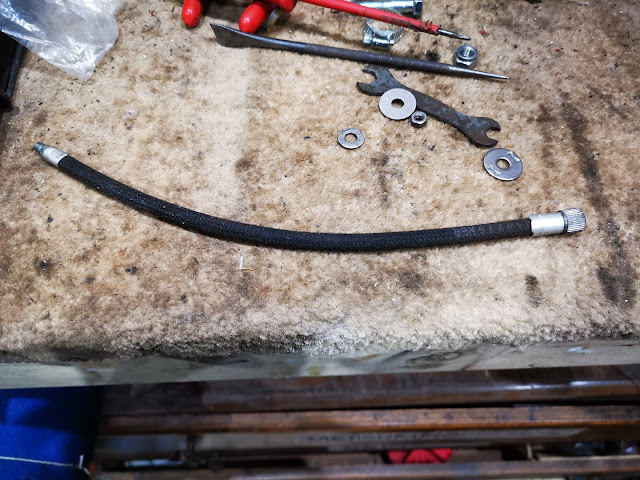
Job done - almost. The connector hose on the pump was completely knackered. Luck was on my side, because although I inflated the tyre with my workshop pump I found I had a genuine Apex pump with its long connector in stock!


Monday, 31 January 2022

Tools - new connector for the FH tyre inflator

 Some of you might have seen my post on Thapex tyre pumps - click here, and the post on making pump washers. As I said before, pumps bought from eBay, autojumbles and car boot sales arrive in unpredictable condition, cracked, with missing or tired washers and almost invariably without their connectors.

This article is about making those connectors, but first a word on terminology.

While researching these things, and looking for a longer pump hose that I could buy, I came to realise that the cycling world doesn't recognise the word 'hose' in connection with cycle pumps - indeed, cycle pumps are a bit passé these days having disappeared in favour of CO2 powered inflators. No - the cycling world seems to use the word 'connector'.

So, here we go. First we need a bit of hose - not too difficult, you can buy 1/4" braided fuel hose on eBay in various sizes - I bought 500 mm of 6.5 x 3mm black cotton braided hose for the princely sum of £2.68.

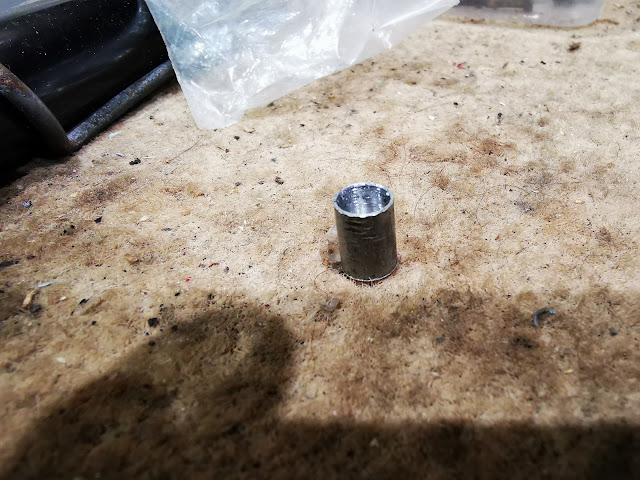
The difficult thing is always the ferrules, whether it is for a push bike or a motorcycle fuel line. They are either hideously expensive or just not available, so along comes another skip raid. Some time in the past I had acquired an aluminium cycle rack, the kind you put your shopping on and cycle home from town. It was full of weld but I had cut it up and stored it in my metal stock bin. It was 8mm OD. It machined well enough to make a couple of ferrules very easily - that is a 7 mm hole in the middle, they are 10 mm long and the 7 mm bore stops 1 mm short of the end. The end is drilled through 4 mm.


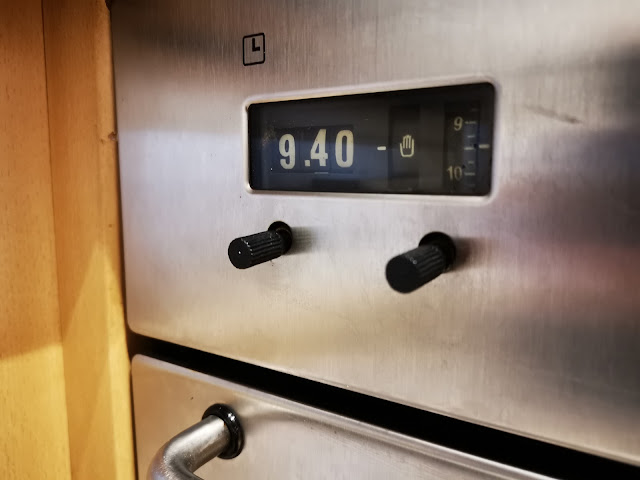
The aluminium bar gave me two replacement cooker knobs as well:


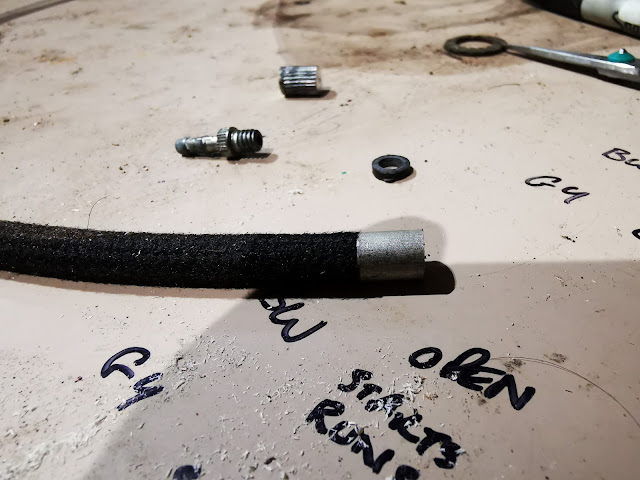
The ferrules fit nicely over the braiding:


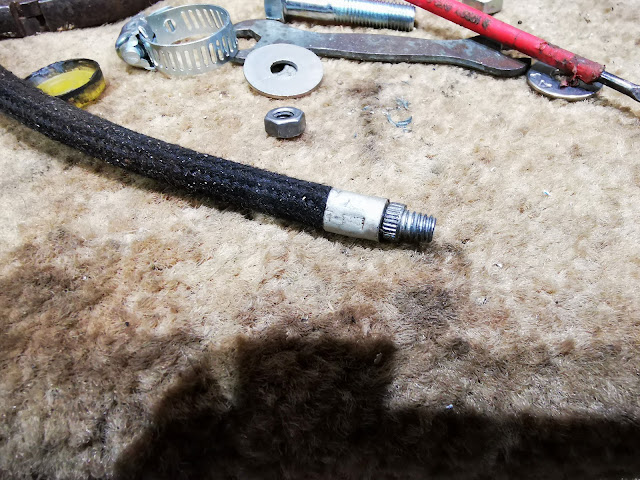
The crimping was done in the three jaw chuck on the lathe:


And the completed article. The length wants to be as long as possible but is defined by how much you can store in the pump:


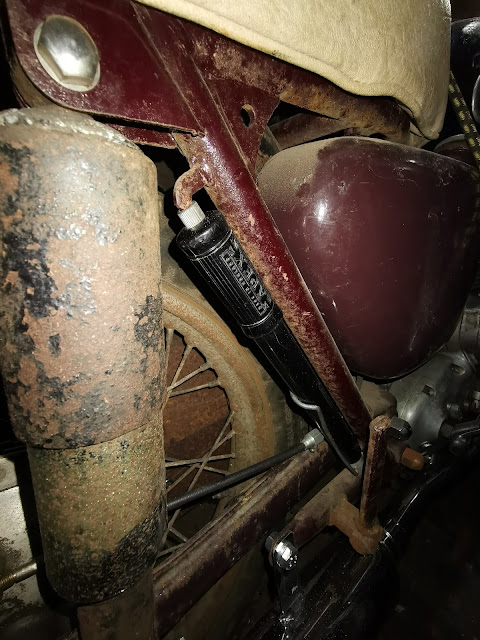
Here's the complete thing on the bike:


Sunday, 30 January 2022

Tools again - New washer for the FH tyre inflator

Some of you might have seen my post on Thapex tyre pumps - click here. As you might expect, pumps bought from eBay, autojumbles and car boot sales arrive in unpredictable condition, cracked, missing or tired washers and almost invariably without their connectors.

Some while back, I bought a nice new washer purporting to fit one of my pumps and it sat on my desk for a number of years until I came to fit it - which of course it didn't. It's about 1 mm too small.


So, time to roll out a lost art shown to me by my grandfather Leslie, who was a serious cyclist - he worked at the docks during the war, and having relocated from West Ham to Ewell had a 18 mile commute to work, which he did twice each day on his bicycle. What you do is this:

Start with a piece of leather, in my case the cuff from an old Jalatte safety boot. For a 7/8" pump, you will want a disc of about 30 mm diameter which you can cut with scissors, or however you want.


Next, punch a hole in the middle. The washer screw in a Thapex pump is 2BA, so a 5 mm punch will do. Next, we are going to form the leather into a cup; before we do that we are going to reduce the thickness of the leather around the edge, a process called 'skiving'. You use a very sharp - no, very, very sharp knife to slice a layer off the surface, reducing the thickness at the edge to perhaps half what it was (the boot was about 2.4 mm thick).


Fix the retaining washer in place with the screw and add a second washer on the back - I used an M5 repair washer on the back and an M8 washer under the screw head, to support the flat part of the washer at the right diameter - all clamped tight with a 2BA nut. Drop the whole lot in a cup of water for a few hours until it is soaked through.


This is a 22mm Jubilee clip - the inside diameter is set to match the inside diameter of the pump. I have pushed the wet washer into the clip to form the cupped shape. Make sure it is square and leave it to dry out.


And that's it - next day, we have one perfect cup washer. I smear the washer in neat's foot oil and assemble it straight away, before it has a chance to return to it's original shape.

Here it is installed:


Tuesday, 31 July 2018

Tyre Pumps

None of my bikes have tyre pumps. I need three tyre pumps. I don't know anything about tyre pumps, and of course I want original pumps that work really well, fit, and look the part. Not much huh?

I don't know who made tyre pumps back in the day, I don't know how to size them, where to buy them, or whether they had tubes or stirrups fitted. Having had a few bicycles I know how they work and could get one working, but beyond that...

So, where did the various motorcycle manufacturers buy them, and who made them? What types of pumps did they use? The ones I have seen are all variations on the bicycle pump theme; no stirrup pumps. Variations are around the materials used; brass pre-war and plastics post-war; and then the air hose connection which takes two forms:
  • end of the pump on smaller bikes and the 
  • side of the pump, with the folding wire 'stirrup' on larger bikes
What size did they use? Bore sizes:
  • 3/4"
  • 7/8"
Lengths
  • 12"
  • 13 1/2"
  • 15" - closed length 14 1/4"
  • 16 1/2"
  • 18"
The pump mounts, and the parts books for my bikes tell me something.
  • Bantam: Inflator PN 40-9026; illustration shows what appears to be an Apex inflator with no stirrup
  • Ariel SQ4: Inflator PN 6636-29, Tyre Inflator 14in. x 7/8in - the inflator does not appear in the illustrations.
  • Ariel FH: Inflator PN 6636-54, Tyre Inflator - again the later parts lists are not illustrated
  • Ariel W/NG: The inflator does not appear in the parts list nor in the tool kit list in the owners manual. However the earlier owners manuals picture the bike with a stirrup-type inflator in the usual position on the top chainguard. Chainguard is 14" between the points of the inflator mounts

Pump Manufacturers

Here are a few that I've come up with:

Bluemels

The English company Bluemel was founded in 1860 in East London by Charles William Bluemel, Ernest Adolphus Bluemel and their brother, as yet unnamed. The Bluemel products quickly gained an excellent reputation in cycling and CW Bluemel & Brothers Ltd. expanded rapidly. In 1902, the company purchased an artificial silk factory from Mr. Joseph Cash in Wolston at Coventry, and in 1904 relocated production there from Stepney. The brothers were rather frightened by the size of their new factory, but the wisdom of their choice was shown when additions had to be made to the premises to accommodate their production.

The company’s portfolio quickly expanded to include parts for motorcycles and automobiles. In 1913, the company became incorporated. 1914 Cycle and Motor Accessories Manufacturer. Specialties: celluloid cycle pumps, handles, mudguards, gear gases, dress guards, sparking plugs and accumulators for motors. Employees 550.

In 1938, Mr. Ernest Adolphus Bluemel, the last of the three brothers, passed away. By this time, the company had expanded from an initial 150 employees to over 600: described as a modern factory, its chief products were plastic mouldings in bakelite, steering wheels (to MG for example), and pumps, and to a lesser degree, bicycle mudguards and gear cases. A second generation of Bluemels, Frank William & Roland Edward, continued to expand the company after the death of the original founders.

In 1948, the company began to manufacture car parts for Jaguar and Austin Martin. By 1961, the portfolio included auto, bicycle, and motorcycle accessories, plastic mouldings, dials, and nameplates. In 1983, the company faced insolvency. British Cycling wholesaler, Chicken, recommended to SKS owner Willi Blome to look at Bluemel’s pump and mudguard company in Coventry.

Models:
  • 'Motorbike' 

Apex Inflator Co. Ltd.

I'm struggling to find any company history for Apex, but I have these adverts:

Apex advertisement from 1927


Apex advertisement from 1931
Advertising tells us Apex manufactured a range of bicycle pumps
  • 'Bailey Super', a 15" pump with a celluloid covered steel liner, 'solid drawn' (seamless) brass plunger tube. The most expensive Apex pump
  • 'Superlite', a 15" celluloid pump with a seamless brass plunger - the lightest Apex bicycle pump
  • 'Lastwell', a cheaper 15" bicycle pump with a celluloid tube and a split steel plunger
Apex also made brass pumps, with seamless brass or split steel plungers. You will notice that none of these pumps have stirrups, and one conspicuously absent from the advertisements is the 'Thapex', which appears to be the one favoured by the motorcycle manufacturers...

Here are a few more bicycle adverts, which are important to this story. You will see why in a minute.
Apex advertisement from 1945

Apex advertisement from 1946

Apex advertisement from 1949

Apex 'Thapex' pumps were widely used by Brtish motorcycle manufactureers; an Advertisement in a 1931 copy of Pitman's 'Book of the Mathcless' by the ubiqutous WC Haycraft advises that Thapex pumps had been used by Matchless for over 10 years.

Charles Britton

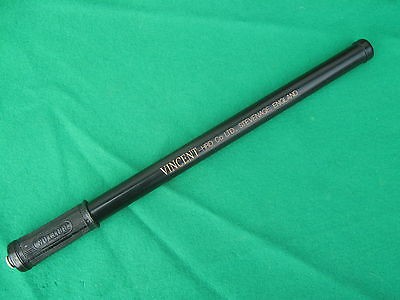
I don't know much about these. Charles Britton was apparently Great Grandfather to TV's Fern Britton; Vincent famously used a 13 x 7/8" Britton pump


Dunlop

Dunlop produced its first tyre for a motor car in 1906. The first rubber estates in Malaysia were acquired, in order to ensure a supply of raw material, in 1910. Construction began on the 400 acre Fort Dunlop headquarters and production site in Birmingham in 1916. Dunlop was the fourteenth largest manufacturing company in Britain by 1918, and its only large-scale tyre manufacturer. It had a market value of £8.9 million in 1919.

Dunlop began to diversify from tyres from 1924. It entered the sports market in earnest when it acquired the tennis racket manufacturer F A Davis. Charles Macintosh, the raincoat manufacturer, was acquired in 1926. The Malaysian estates were expanded over time, and Dunlop was the largest single landowner in the British Empire by 1926.

By 1930, Dunlop was the eighth largest public company in Britain, with a market value of £28.2 million. The company was a major industrial supplier for Britain during the Second World War, producing the bulk of rubber tyres and boots for the war effort.

By 1946, Dunlop had 70,000 employees, and sales outlets in nearly every country in the world. By 1948 Dunlop was the tenth largest British company, with a market value of £55.9 million.

Dunlop’s fortunes were closely interlinked with the British car industry. In 1950 Britain was the world’s second largest car manufacturer, and the world’s largest exporter of cars. Many of these cars were fitted with Dunlop tyres. In the 1950s Dunlop accounted for almost half of all tyre sales by value in Britain.

By 1955 Dunlop employed 100,000 people, and was the second largest private employer in Britain after ICI. In 1959 Dunlop was the twelfth largest company in the world outside the US.

Dunlop began to decline from the early 1960s as it was slow to adapt to the new market for steel-belted radial tyres. Performance was also undermined by the decline of the British car industry.


Pumps from Around the Internet

Internet research, using various keywords and spellings reveals a number of pumps, designs and manufacturers:

Unknown Brass Pump


BSA PN 27-8958, Inflator for WM20


Bluemels 'Motorbike'


Dunlop Inflator

An EBay sale, this inflator was fitted to a 1956 Triumph T110. The design of this pump suggest it was made by Apex.


Similar handle style to a Thapex?


Similar end cap to a Thapex?


Similar engraving to a Thapex?

Pumps and Ariels

Apex Pump on Ray Tolman's 1937 RH

Handle from Ray's pump

Original APEX from David Andersen's 1949 RH

Original APEX from David Andersen's 1949 RH

My Pumps

I've bought two Apex pumps for two of my Ariels, both speculatively, both from eBay. Here we go:

Early Thapex

This is a pre-1949 15" x 7/8" Thapex, that will go on the SQ4 - Its pretending to be old stock, sitting on a shelf at Selly Oak until it was fitted to my SQ4 in 1951.


It's got a black painted stirrup with no evidence of plating


It's got the early style handle, shown in the 1927 advert and also in the 1949 advert as the 'old style'


It's go the early logo on the body sleeve


It's got 'Made in England' moulded into the end of the handle.


It's got a steel end connection and a plated brass gland with a relatively light internal buffer spring.

Later Thapex

This one is post 1949 - there is a later style, but this is not it...


Very similar design, with some detail differences. Celluloid coated steel body again...


Post 1949 handle with 'Made in England' moulded in - very similar to the Dunlop pump, do you think?


New body logo, engraved and filled with gold paint


Alloy end cap, with cadmium plated stirrup


This one has it's washer and fittings. Notice the buffer spring is heavier, and the gland nut is Bakelite; that round head screw is 2BA and fits in a square nut pressed in to the plunger tube.

This one is fitted to my 1958 Ariel Huntmaster.

Pump Repairs


There are a couple of posts on repairing these pumps: