Showing posts with label oil pressure. Show all posts

Saturday, 9 August 2025

SQ4 - after the service

 A few little teething troubles appeared after the recent service, most notable of which was the oil pressure. Normally the oil pressure sits at 75 psi when cold and rolling at main road speeds, dropping to 25 psi idling after 15 miles or so.

Today, it was going up to 75, but intermittently dropping to 40 or so - very odd. I bled the Morgo again:

When that appeared to be happy - there were no bubbles I turned my attention to the relief valve.


See that bit of debris half way along the spring? I cleaned that out, and after a suggestion from Richard in the AOMCC, I changed the ball and reseated it.

I then rode to Cromer and back, clocking up about 13 miles - until it warmed up, it sat solidly at 75 psi and was still showing 50 psi when I got home. Back to normal.

It’s a bit snatchy at low speed. Initially I thought this was carburetion (not that I have changed anything), then perhaps transmission snatch, but all is normal there.

I’m going to retard the timing a bit.

Monday, 21 October 2024

FH - we have oil! And where we want it!

 Today I applied a bit more elbow grease to the ratchet spanner I was using to turn the mainshaft and attempt to get some oil circulating in the engine. I realised that if I put the machine in fourth gear I could achieve the same thing turning from the rear wheel, perhaps with a bit less effort because I'd have the full diameter of the wheel as leverage to turn the engine. 

This worked really well and I was able to get the engine moving quite quickly by pulling on the tyre. I persisted with this routine each time I visited the workshop during the day.


Suddenly, it all started to get easier. This happened with the Square Four - the oil reaches the major bearing areas and they start to slide much more freely. I decided to give the big drill another try.

Even turning the wheel I had started to see a lot of oil around the pump. This would be emerging from the cam and idler bearings I think. With more engine speed derived from the drill, this area became a lot wetter but I still wasn't getting anything at the tank.


I was on the verge of giving up for the day and heading home for some tea, when oil appeared at the tank return. It takes a while to get up here when you have a filter, because of course the filter has quite a significant volume to fill:


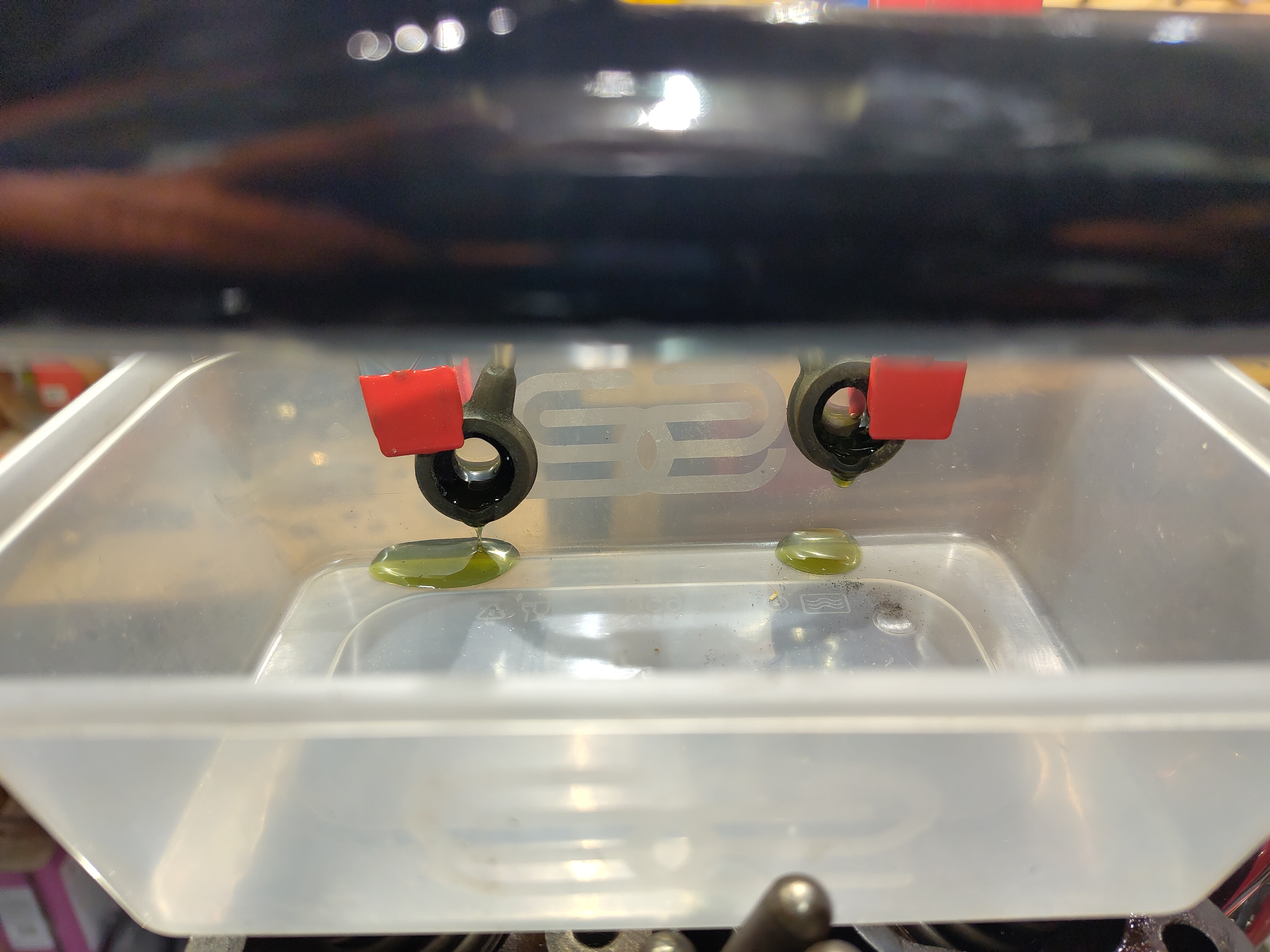
A couple more minutes on the big drill had oil appearing at the rocker feed banjos.

So that's that - very pleasing. The next step is to close it all up and get it running. Oh, and by the way - this is Morris SAE 30 Running-in Oil. I'll be using Morris SAE 40 generally.

Sounds so easy when you say it like that!

Sunday, 20 October 2024

FH - creeping forward

 That hasn't been much of a week. My wife and I have both been in bed with the flu, so nothing much has happened on any of my bikes or any other job come to that; I even had to cancel a railway trip this week. 

However, the oil tank is hooked up and I started to try and crank over the engine using the gearbox mainshaft nut as an access point. It was quickly shown to me that using a power drill here was not an option, because of course we're driving through the clutch and a primary gear ratio to get to the engine unlike the last time I did this which was directly to the square four front crankshaft.

I've been cranking by hand using a half inch ratchet spanner. I've got oil at the relief valve:


I've got oil at the return filter, which proves that the return filter union connections weren't tight enough. 


Trouble is I don't have oil at the tank return connection yet, nor at the rocker box banjo connections:

More cranking required. Maybe I’ll roll it down the hill?

Friday, 3 June 2022

SQ4 - Oil Leak from the Rocker Feed

 This may be a seminal moment in the history of my SQ4. For years it's had an oil leak which I have always assumed to be poorly sealed pushrod tunnels at the head joint. However, having addressed a problem with a leak from the oil tank cap, something else which it has always done, I resolved to look at the drip from the rocker feed pipe. 

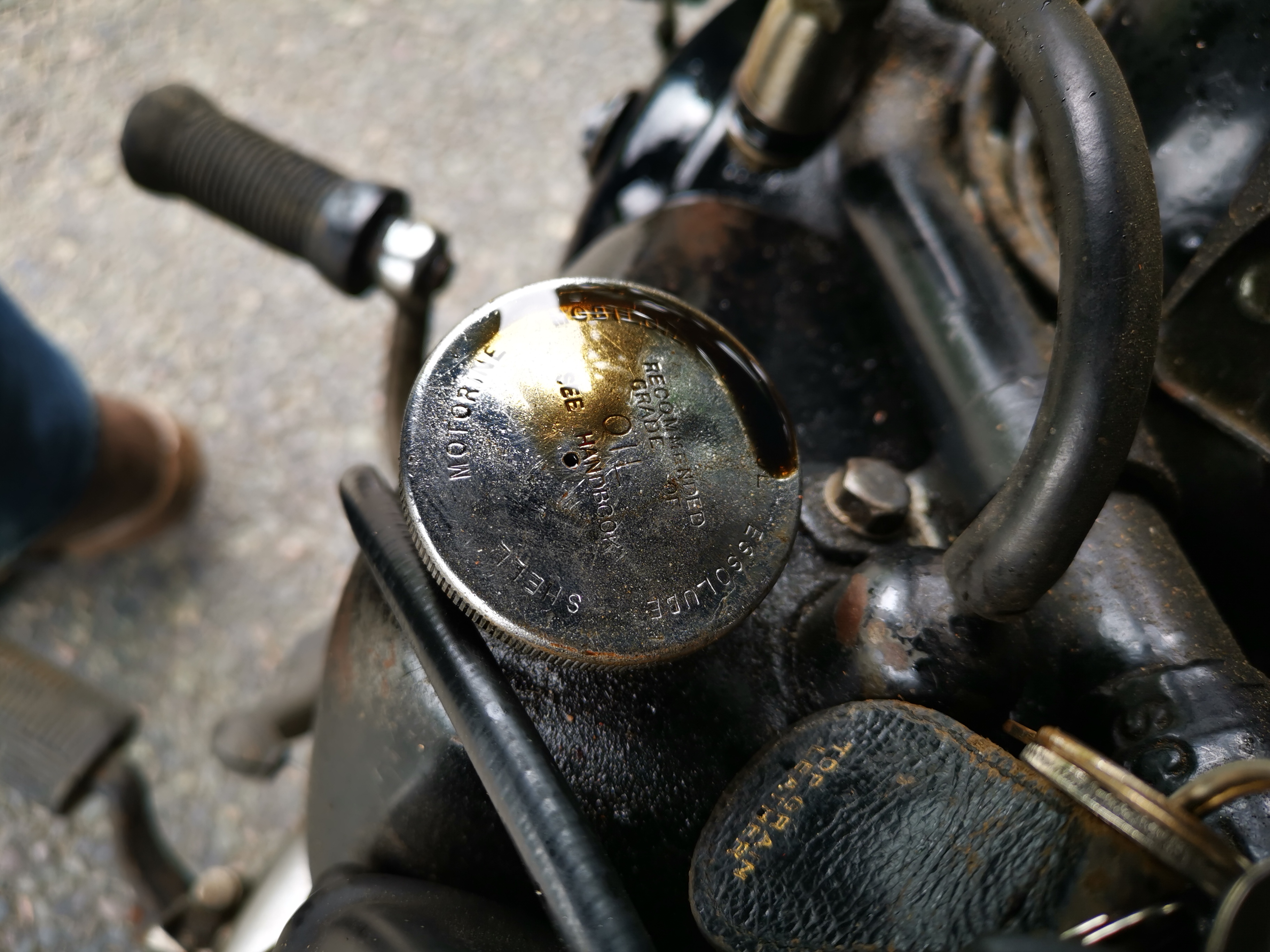
The oil tank cap has always had a weep from the breather:


Which translates to a wet leg on a long, fast run:

Looking at that first picture, I got to wondering why the cap has a vent hole when the tank has a piped breather that I have taken past the rear wheel. Surely the cap should be sealed?

It turns out that Square Fours don't use the same cap as other Ariels. I noticed that the 1951 SQ4 parts list has a -32 number for the cap - most bikes (other than Square Fours) I've seen use a -29 number. Maybe 5854-32 has no breather hole.

A blob of solder will sort it.

Onto the rocker feed. I ran the engine cold (75 psi on the gauge) and as the oil warmed up the leak appeared:

Now, my bad - I forgot to take a camera to the workshop when I fixed it. It turned out the tube was not pushed into the fitting at all - it was just held in place with a fillet of solder at one end, and had been like that for years - probably eight years. It's been leaking for most of that.

All fixed now.

Friday, 23 October 2020

W/NG - Oil pressure

One of the more hair-raising aspects of rebuilding an engine is making sure the lubrication system is working before you go out on it. You fire it up, and then hold your heart in your mouth waiting for the spurts of returning oil coming into the tank to tell you that all is well.


When I built the SQ4, I ran the engine up on a big power drill, as I wrote in this post. I should maybe have done that this time, but I have sealed up the primary case now and anyway the drill might undo the shock absorber nuts - you cannot get to the timing side of the crankshaft on a single, with the oil pump in place.

You are reduced to some right leg exercise on the kick starter. Waiting for oil to come back in the return will take a long time, but you can see it much sooner either here, at the blanked oil pressure gauge take off:


or here, at the rocker oil line connection to the timing chest. Slackening either fastener should see oil dripping out if all is well with the pressure side of the pump. 


Of course, oil at these two points does not mean it is getting to the big end - you will have to wait for it to drip out of the sump plate (if that is still off) or return to the tank.

You'll have to cope with living on adrenaline and biting your nails for a bit longer.


Tuesday, 18 June 2019

Brown Trouser Moment

I've had a few nervous moments in SQ4 ownership, shared by several co-owners if the stories on the AOMCC forum are anything to go by. Not least of these are the few occasions where oil pressure has suddenly and completely disappeared, accompanied by a more or less continuous return flow to the oil tank.

Fortunately, the first time this happened was on start up - or at least, that's when I noticed it. Investigation was interesting - removing the front main bearing cover to look at the oil pressure relief valve revealed that the spring had become caught in the split pin, and the split pin was now part way down the spring, preventing the spring exerting any pressure on the ball and allowing it to come off it's seat.

I put it back, noting that the direction the spring was wound in would always allow that to happen and wondered if original springs are wound in the opposite direction.

It happened twice more - once outside a smoke house along the coast. Knowing what it was, it was any easy fix if a little nerve racking - everything was rather hot, and I was nervous of losing small parts in the dirt. However, I was buoyed up by another motorcyclist stopping to see if I was OK.

The next morning, the same thing happened - very low, but not zero, oil pressure on start up. It had happened again.

I needed to do something. The spring lives in a bore which is a little over 6 mm - I can't measure it, but a 6 mm drill is a rattle fit while a 1/4" drill won't go in. The spring is about 5.5 mm OD and 4.5 mm ID:


I planned to make a brass cap to house the end of the spring, preventing the split pin from coming into contact with the coils.

However, I came across this cable ferrule which fitted beautifully. all I have done with it is to drill it out to 3.5 and use a needle file to open it a little more - all the relieved oil has to pass through this hole:


This works perfectly, and makes it much easier to get the split pin in.

Saturday, 26 May 2018

Still Shaking

The summer is coming, the days are warming up and we need to get happy with the Square Four. Regular readers will know that it's overheated the carburetter and the chain is rubbing on the lower chain guard, but I have also noticed that the steering has been a little wayward - wayward in a 'I want to turn right' sort of way.

Having fitted the carburetter insulating gasket, it is time for another run out, this time to Aylsham M&S ostensibly to buy some rum. Initially we can see that the rear brake seems to be OK, while the front still needs some bedding in. The chain is still thrashing the chainguard.

Out in the country

Aylsham M&S, stopping for fuel
After a 12 mile run down to Aylsham we stopped for rum & fuel. I was delighted to find that I could comfortably put my hand on the carburetter float bowl - no boiling fuel here today and no misfire on the whole run. The oil pressure had been at a steady 50 psig running and about 25 psig idling so I'm delighted with that, and there doesn't appear to be any leaks either.

However, getting home there is oil all over the oil tank and the toolbox, again. This is a problem that has been recurring over a few years and I have always just cleaned it off, pretending it was down to the duff thread in the old oil tank. This time however, you will recall that have replaced the oil tank for one with a good thread, so that excuse has gone.

A short investigation reveals no seal in the tank cap... Did I really never notice that in the 6 years I have had this bike? Easily fixed fortunately.

Looking at the wheel alignment again, after the bearings were replaced in the winter, seems to be a good approach to isolating the steering problem. A few minutes with a straight board reveals a wayward rear wheel and a few minutes with the bike's toolkit it is easily fixed.


While I was under there, I had another look at the chain run and the lower chainguard. Yet another bit of judicious bending and we are done. Now we need another road test!

Monday, 7 May 2018

Shaking Down the SQ4

A beautiful day and a bunch of spare time - the opportunity I have been waiting for to sort out the remaining SQ4 jobs and shake it down ready for the summer.

First off, check the oil in the primary case, which is all OK; the primary chain is suitably tight as well. Next, add 200 cc of SAE 30 to the fork leg we repaired, then tyre pressures, fuel and oil levels and then finally get out on it to warm it up for the oil change. A trip along the coast road on a hot day reveals that the rear chain is still rubbing on the lower guard, and after six miles of caravans & Bank Holiday tootlers the rear brake starts to feel unusual - a kind of vibration through the pedal. I was approaching Salthouse at the time, and I decided that this was only a shakedown run and that I ought to turn back. On a hot day, I reasoned, the oil will be hot enough to change after 12-13 miles.

Salthouse Village Green
That was when it all started to go wrong. I managed to follow a bus and two caravans out of Salthouse, and by the time I had put another mile under the wheels the misfire had appeared. Power was really down and I had to drop to third on all the hills. Forgetting what the Four can be like in hot weather I was worrying about the ignition system, but managed to crack on home - I was overtaken by a military M20 at one point, as I could only manage 20 mph. At least my newly refurbished speedo was working perfectly, as was the charging system. Oil pressure was over 50 psi all through the trip - dropping to 25 psi on tickover which I was very pleased with, but remember it is still running Penrite Shelsley Heavy 40W-70.

Back home, I put the bike back in the workshop and drained the oil tank, the sump and removed the filter. Sitting by the oil tank, I could hear the fuel boiling in the float chamber, and my Infra Red thermometer revealed that the float chamber was at 80°C and the carburetter body, near the cylinder head flange was over 100°C - and remember, I had already spent 15 minutes draining the oil at this point.

So, I must fit that Phenolic spacer and maybe a carburetter heat shield. There is probably enough room for about 4-6 mm of phenolic - I have some 3 mm Phenolic sheet at the minute. I may have to change the carburetter mounting studs but I think I will test out the spacer with half-nuts before I go to the bother of making new studs.


Looking briefly at the brakes, I probably have the rear nipped up too tight; the drum was smoking hot. The front had a bit more play when I got back and was working normally showing no signs of overheating. I will remove the rear wheel in a day or two.

So, after cleaning up the mess, I proceeded to remove the oil tank to exchange it for one with a good filler neck thread. I'll repair the old one in due course. All nice and tidy in there:

Look no oil tank
Fitting the new tank reminded me what a tight fit they are. My old tank had a relieved area under the frame tube, so I recreated this with a panel beater:


Next, having spent an hour winkling it into place, I remembered that the gearbox top nut has to be removed to get enough clearance to allow the bottom mount back into place. All fixed and back together now.

This year I will be mostly using... Penrite Shelsley Medium 25W/70:


Friday, 15 September 2017

SQ4 - Oil Line Mod

I'm having a few issues with oiling at the minute, some of which are due to my own stupidity and some of which are not.

I have had persistent problems with the feed union to the cylinder head, which despite re-tightening on several occasions has always backed off after a few hundred miles. Seeking advice on this on the AOMCC forum, Nev Hunter from Australia pointed out that it was the fibre washer I was using that was at fault. This area gets so hot that it will cook a fibre washer...


In this location you must fit a copper washer:


The second problem was not of my making. There are two oil lines leading up to the cylinder head from the crankcase; from the front main bearing as shown in this diagram of the 4G, and from the rear main bearing, a banjo under the timing cover on later bikes. The assembly consists of two lines _ a 3/16" line for the gauge, and a 1/8" line for the rockers which seems illogical but the 1/8" line is there to choke the feed to the rockers and to maintain back pressure at the main bearing.

Pressure loss in a pipe is affected not only by the size of the hole but also by the length of the pipe, so that long, small pipe to the rocker creates a restriction in oil flow to the rockers which has the effect of increasing oil pressure at the banjo, and hence increases the pressure the gauge sees. Mathematically, the effect is demonstrated to engineers by the Darcy-Wiesbach equation which has been useful in most of my oilfield career when predicting the performance of hydraulic fluids and chemicals racing along thousands of meters of small bore lines and back.
Problem was, several assemblies are out there that are the wrong way round, which results in over-oiling to the rocker box and a gauge that under-reads (since the oil pressure to the rockers is lower), so we will set about fixing the problem.


4G Lubrication System

You need to take the tank off to have a look.


Here are the oil lines - the 1/8" pressure gauge line and the 3/16" rocker feed line. We are going to swap these around:


Here I've cut the old 3/16" rocker feed line and fitted a 1/8" equal union, which will mate directly with the existing line to the gauge:


Using the remains of the existing 3/16" rocker oil feed, just the last few inches to the head, I've fitted a 1/8" nipple & nut to mate with the old gauge line coming from the double banjo under the timing case. In this picture, I'd kicked the engine over to prove I had oil coming out of those lines:


I took this picture after the first road test, when I discovered that the rocker box soldered joint had failed - poor penetration caused by bad fluxing or low heat:


From the beginning of the rebuild, my Four has exhibited the same behaviour with respect to the oil pressure, namely that it will show about 55 psi cold, idling or on the road - governed by the relief valve. This drops to about 25 psi at 40 mph when really hot, and about 10 psi at idle - all this on Penrite 40/70.


Now that I have the rocker box/pressure gauge oil lines the right way round, its completely changed. Same oil, but now I see 60-65 psi cold, and about 50 hot; this drops to 25 psi at a hot idle.

I'm a happy chap. I might go back to a lighter oil, just so I can kick it over in the winter without a hernia.

Monday, 8 August 2016

Oil Pressure

So how is the oil pressure situation now we are into the summer riding season? Amelia's engine is loosening up nicely but I am nervous every time I dip my head to look at the pressure gauge between my knees. This summer, we are in the low-mid twenties (degrees C) and the gauge is still showing the 10 psi at idle, 25 psi at 40-50 mph that Mark Walsh described in this blog post:

http://ariel-square-four.blogspot.co.uk/2015/03/temperature-testing.html

My initial runs were done on a cheap 20W/50, followed by Morris SAE 50. Nothing wrong with this oil, but with a new build engine it was difficult to start and after a few hundred miles the gauge was dropping to near zero at idle. I then discovered Penrite Shelsley Heavy, which is 40W/70 and is designed for older engines with some wear - you all know that my big ends have not been reground and are near the factory wear limit; I did this because they were just about within tolerance and I did not want to risk ruining my cranks with a poor grind.

With this oil, it's quite difficult to turn the engine over in the winter (down to zero Celsius), but there is a Shelsley Medium (25W/70) which I might try; the upside is that the pressure is always above 10 psi, and sees 25-30 at higher speeds. The engine is loosening off now and the bike is starting to really fly! I'm hoping that the loosening off will see some reduction in temperature which in turn will increase the oil pressure a little.

The real truth though is that I am going to have to bite the bullet and get the big ends reground at some point.

Watch this space!

Monday, 13 April 2015

Trip to the Seaside


After an uneventful run up to Sheringham, North Norfolk.

This may not seem much, as a 27 mile trip, but its the first time that I have been out riding on a route that was not circular around my home - the idea being that as you shake the bike down the radius gets larger. The first trip I do on a rebuilt machine goes out of the gate and I turn left and keep turning left until I get back, 10 minutes later. I increase the radius of the circular route as I get more confident with the machine.

As you all know, I have been having overheating problems leading to low oil pressure; as many people have said, Mk1 engines run very hot when newly built - at the end of this trip, the SQ4 had clocked up 117 miles since rebuild. 

So, following your advice, I am breaking it in slowly and keeping an eye on the oil pressure. I'll run it around each day and build up some miles.


Friday, 26 December 2014

Oil & Oil Pressure

So this is one of those posts that we use to collect thoughts.

Amelia has done about 25 miles, and has had her head torqued down and the oil pressure relief valve spring replaced. She is running in on Tetrosyl 20w/50 multigrade oil, to API SE spec. When cold, the oil pressure gauge shows about 55-60 psi at idle speeds; after a 6 mile run around town, at speeds up to 25 mph or so, the oil pressure drops to almost zero at idle.


Darcy's Law tells us that flow through an orifice is proportional to the area of the orifice, the pressure drop across the orifice and the viscosity of the fluid.

The viscosity of the 20w/50 will be something like 18 centistokes at 100°C, rising to something like 135 cst at 40°C. After the run, the oil was visibly very free flowing and hot.

The relief valve may be controlling the pressure at idle - it may prevent the pressure exceeding 55-60 psi, but if this is the case it will have no effect at higher temperatures unless it is stuck open which seems unlikely given that the pressure displayed on the gauge falls gradually as the temperature rises.

Additionally, the effect is repeatable - the cold idle oil pressure is always 55-60 psi, and it always drops to near zero when it is hot, so I do not think we are seeing mechanical changes in the relief valve or the engine clearances - yet.

The Morgo is a gear pump which requires clearances between its gears to operate, and these clearances will allow more fluid to slip ineffectively around the gears when the viscosity is low. Are we right to fit gear pumps when the engine runs so hot?

And then there is the gauge. Ariel indicate that these engines should run at about 40-45 psi on SAE 50, so my gauge readings are not unreasonable, but we don't really know how accurate the gauge is or even if its accuracy is linear.

But one thing is clear - when the oil is hot (and we don't yet know how hot it really is) the loss in viscosity is such that the pump can push its full flow capacity (which itself may be compromised by low viscosity) around the engine without creating any pressure in the system.

And pressure is needed to prevent the bearing surfaces coming into contact with each other.

Wednesday, 3 December 2014

Oil... everywhere

So a few days later and I run the engine with the front main bearing cap off. I'm not going to show you a picture, because there would be oil everywhere, but you can see from this shot with the cap loose that there is oil there; with it off it gushes out:


And here we have a new spring just arrived from Draganfly, about 25% longer and somewhat stiffer than the old one:


And here we have an oil pressure gauge showing a previously unreached figure, 55 psig, at tickover - engine relatively cold (about 5 minutes running). Thats more than 50% up on last time.


So now we need a road test. Yippee!


Saturday, 29 November 2014

Another Four Miles


Well, I have had the timing cover off and the pump is solid, so I have stripped the relief valve to reseat it. Oil pressure after a four mile run today is much the same, as we await the new spring.

Still, she's running a treat and she looks lovely!

So to get my head around engineering behind the oil pressure regulator I need to confirm what size the ball seat is, i.e. the diameter of the oilway in the offside end of the front crank. The ball is 3/16", so the seat must be maybe 5/32"? I'm trying to understand what the spring rate would need to be for a given back pressure in the system.

For example, a 5/32" seat would give an area of 0.019 sq in. exposed to pressure, so a 1 lb spring would give me about 50 psi. My existing spring is not that heavy (its the original one, new one on the way) and, surprise surprise, does not achieve 50 psi on the gauge - thats assuming the valve is ever opened!


I plan to have a look and see if the regulator valve is used next time I run the engine, and I will have to find a way of calibrating the pressure gauge..

Monday, 24 November 2014

Latest trip

Well, a bit more news today, and a four mile trip around town. 

The fuel filter has gone back in the spares box to be replaced by a plain pipe and a gauze strainer in the carburettor banjo - all air locks now banished to the spares box along with the fuel filter. Apart from a very fast tickover, all seems well in the fuel department.

I've been looking at more loose ends. I had meant to look at the chain oiler screw in the primary case for a while, since the thread in the primary chain case was refusing to allow the oiler screw to pass through it. I measured it, found it was 2 BA and cleaned it out only to realise that the screw I had was just an old carburetter mixture screw and was way too short. This is what it is supposed to look like:


Thanks to Steve Clarke for this picture.

The clutch has seen some adjustment and a much better cleanup job on the splines. It's dragging a little, but a vast improvement over what I had. Changes whilst riding are noiseless - engaging first at a standstill is still noisy but much less so. By the time I had got back it seemed to have loosened up and needed adjusting again.

The electrics are all behaving themselves; the handling is also fine but as I have discovered before I need to keep an eye on the tyre pressures - 28 in the front and 24 in the rear seems to be about right, and the consensus of opinion canvassed on the splendid AOMCC forum.

I've re-torqued the head, as regular blog readers will know. Cold, the oil pressure is about 35 psi - but this dropped to about 10 psi with the engine hot, so do we think the relief valve could be due for a new spring? AOMCC wisdom suggests that the Morgo pump may have loosened off (thanks Mark) so we will have to have a look at that before the next trip. I will get a new spring for the relief valve as well. It's getting properly hot now, but the engine is quiet and I have no exhaust or oil leaks.

Looking forward to the next trip!

Tuesday, 26 August 2014

Happy Day!

Well... What a day!

As you know, I had run up the oil pressure on the power drill, and everything was connected so there wasn't really any excuse not to try and light her up. Initially I had a few issues getting the fuel into the carburettor, some sort of air lock, but once that was sorted, away she went!

YouTube video: Amelia Awakened 
YouTube video: Amelia's Oil Pressure 

And doesn't she look great with her exhaust wrappings off!


Thanks to everyone that's provided help, encouragement and bits over the last three years.

Friday, 22 August 2014

Oil Pressure

So as I have mentioned previously, my plan was to spin the engine up on the big power drill. I've now done this using a 1/2" square driver with a hexagonal shank in the drill chuck, with the drill set to 2nd gear - slow speed, high torque. The drill drives the engine through the crankshaft nut under the oil pump.


I connected a short hose to trap any fluids coming out of the oil pressure gauge line and take them back to the oil tank. Because of course the timing cover is off, there is a lot of oil in the drip tray which comes from the rear main bearing. 

The plugs are out to reduce the torque required from the drill.


And here it is:

Evidence of oil emerging from the return line. When the drill is running, you can see this pouring out, and you can see it at all eight rockers as well. Its noticeable that the inlet rockers get a lot more oil than the exhaust rockers - Ariel should have adjusted the size of the oil holes (smaller in the inlet rockers) to increase the feed to the exhaust rockers.

After a few minutes on the power drill, the bike is noticeably easier to kick over. Next I refitted the rocker cover studs and I put the tank and the oil pressure gauge back on and ran the test again looking for measurable oil pressure.

At maybe 250 rpm on the drill I am getting something like 25 psi.