Showing posts with label gauge. Show all posts

Friday, 3 June 2022

SQ4 - Oil Leak from the Rocker Feed

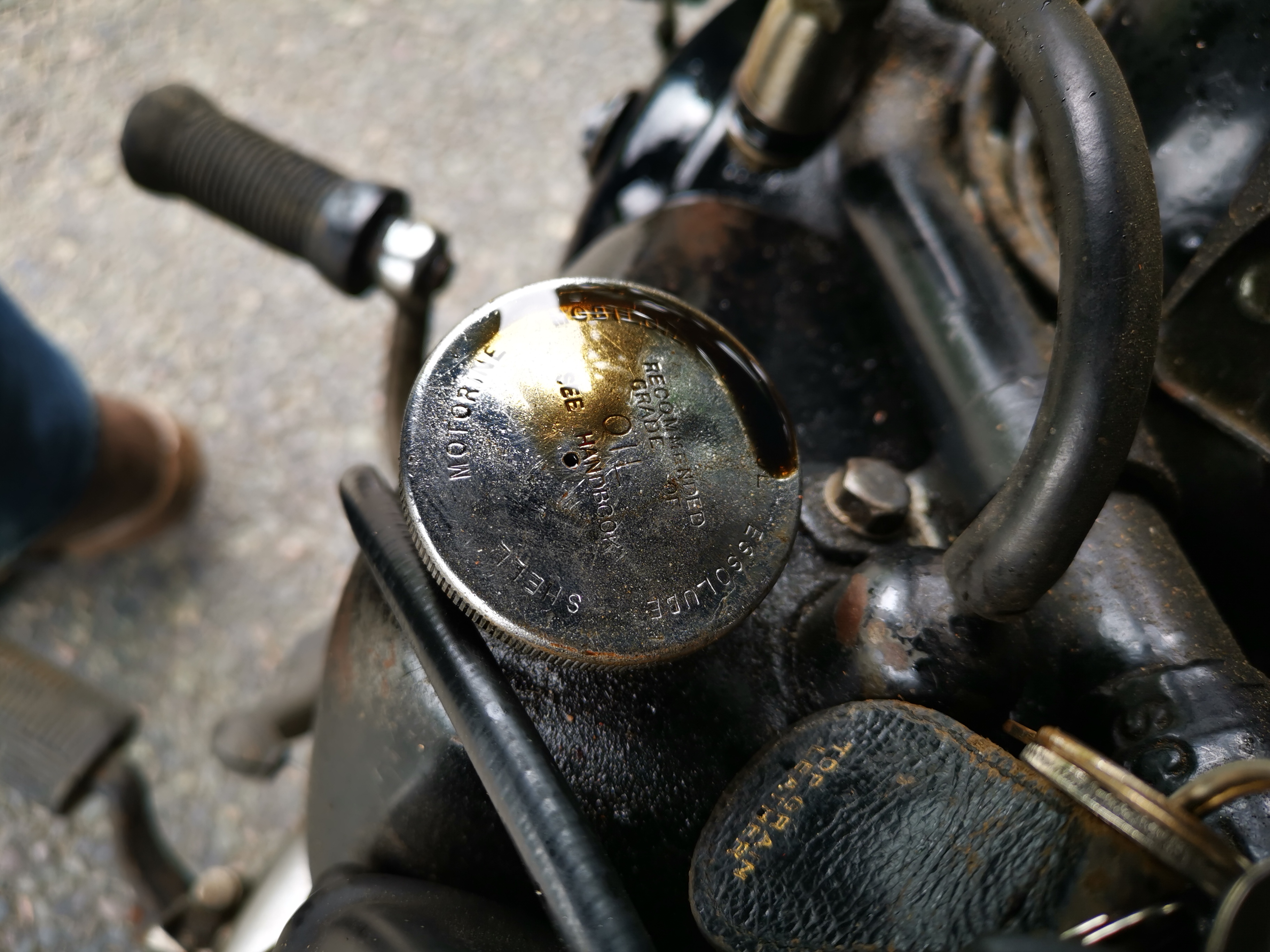
 This may be a seminal moment in the history of my SQ4. For years it's had an oil leak which I have always assumed to be poorly sealed pushrod tunnels at the head joint. However, having addressed a problem with a leak from the oil tank cap, something else which it has always done, I resolved to look at the drip from the rocker feed pipe. 

The oil tank cap has always had a weep from the breather:


Which translates to a wet leg on a long, fast run:

Looking at that first picture, I got to wondering why the cap has a vent hole when the tank has a piped breather that I have taken past the rear wheel. Surely the cap should be sealed?

It turns out that Square Fours don't use the same cap as other Ariels. I noticed that the 1951 SQ4 parts list has a -32 number for the cap - most bikes (other than Square Fours) I've seen use a -29 number. Maybe 5854-32 has no breather hole.

A blob of solder will sort it.

Onto the rocker feed. I ran the engine cold (75 psi on the gauge) and as the oil warmed up the leak appeared:

Now, my bad - I forgot to take a camera to the workshop when I fixed it. It turned out the tube was not pushed into the fitting at all - it was just held in place with a fillet of solder at one end, and had been like that for years - probably eight years. It's been leaking for most of that.

All fixed now.

Friday, 15 September 2017

SQ4 - Oil Line Mod

I'm having a few issues with oiling at the minute, some of which are due to my own stupidity and some of which are not.

I have had persistent problems with the feed union to the cylinder head, which despite re-tightening on several occasions has always backed off after a few hundred miles. Seeking advice on this on the AOMCC forum, Nev Hunter from Australia pointed out that it was the fibre washer I was using that was at fault. This area gets so hot that it will cook a fibre washer...


In this location you must fit a copper washer:


The second problem was not of my making. There are two oil lines leading up to the cylinder head from the crankcase; from the front main bearing as shown in this diagram of the 4G, and from the rear main bearing, a banjo under the timing cover on later bikes. The assembly consists of two lines _ a 3/16" line for the gauge, and a 1/8" line for the rockers which seems illogical but the 1/8" line is there to choke the feed to the rockers and to maintain back pressure at the main bearing.

Pressure loss in a pipe is affected not only by the size of the hole but also by the length of the pipe, so that long, small pipe to the rocker creates a restriction in oil flow to the rockers which has the effect of increasing oil pressure at the banjo, and hence increases the pressure the gauge sees. Mathematically, the effect is demonstrated to engineers by the Darcy-Wiesbach equation which has been useful in most of my oilfield career when predicting the performance of hydraulic fluids and chemicals racing along thousands of meters of small bore lines and back.
Problem was, several assemblies are out there that are the wrong way round, which results in over-oiling to the rocker box and a gauge that under-reads (since the oil pressure to the rockers is lower), so we will set about fixing the problem.


4G Lubrication System

You need to take the tank off to have a look.


Here are the oil lines - the 1/8" pressure gauge line and the 3/16" rocker feed line. We are going to swap these around:


Here I've cut the old 3/16" rocker feed line and fitted a 1/8" equal union, which will mate directly with the existing line to the gauge:


Using the remains of the existing 3/16" rocker oil feed, just the last few inches to the head, I've fitted a 1/8" nipple & nut to mate with the old gauge line coming from the double banjo under the timing case. In this picture, I'd kicked the engine over to prove I had oil coming out of those lines:


I took this picture after the first road test, when I discovered that the rocker box soldered joint had failed - poor penetration caused by bad fluxing or low heat:


From the beginning of the rebuild, my Four has exhibited the same behaviour with respect to the oil pressure, namely that it will show about 55 psi cold, idling or on the road - governed by the relief valve. This drops to about 25 psi at 40 mph when really hot, and about 10 psi at idle - all this on Penrite 40/70.


Now that I have the rocker box/pressure gauge oil lines the right way round, its completely changed. Same oil, but now I see 60-65 psi cold, and about 50 hot; this drops to 25 psi at a hot idle.

I'm a happy chap. I might go back to a lighter oil, just so I can kick it over in the winter without a hernia.

Wednesday, 3 December 2014

Oil... everywhere

So a few days later and I run the engine with the front main bearing cap off. I'm not going to show you a picture, because there would be oil everywhere, but you can see from this shot with the cap loose that there is oil there; with it off it gushes out:


And here we have a new spring just arrived from Draganfly, about 25% longer and somewhat stiffer than the old one:


And here we have an oil pressure gauge showing a previously unreached figure, 55 psig, at tickover - engine relatively cold (about 5 minutes running). Thats more than 50% up on last time.


So now we need a road test. Yippee!


Friday, 22 August 2014

Oil Pressure

So as I have mentioned previously, my plan was to spin the engine up on the big power drill. I've now done this using a 1/2" square driver with a hexagonal shank in the drill chuck, with the drill set to 2nd gear - slow speed, high torque. The drill drives the engine through the crankshaft nut under the oil pump.


I connected a short hose to trap any fluids coming out of the oil pressure gauge line and take them back to the oil tank. Because of course the timing cover is off, there is a lot of oil in the drip tray which comes from the rear main bearing. 

The plugs are out to reduce the torque required from the drill.


And here it is:

Evidence of oil emerging from the return line. When the drill is running, you can see this pouring out, and you can see it at all eight rockers as well. Its noticeable that the inlet rockers get a lot more oil than the exhaust rockers - Ariel should have adjusted the size of the oil holes (smaller in the inlet rockers) to increase the feed to the exhaust rockers.

After a few minutes on the power drill, the bike is noticeably easier to kick over. Next I refitted the rocker cover studs and I put the tank and the oil pressure gauge back on and ran the test again looking for measurable oil pressure.

At maybe 250 rpm on the drill I am getting something like 25 psi.

Thursday, 14 August 2014

Oil Pressure Gauge

So the electrics are done and the oil system is next. As you can see from this pic, there is a lot of paint in the oil pressure gauge hole:


Easily sorted with a flap wheel in a hand drill (very very low speed)


Lovely


Oil pressure gauge lines:


What's left?

Lots of bits and bobs left to do, but at least the electrics are done. No pictures, but after blowing a couple of fuses due to an ignition circuit fault in the ammeter panel, and some poor connections to old bulbs, I have a fully functioning electrical system. Only a few items left:

  • a link between the brake pedal and the brake lamp switch
  • the speedometer bulb is not working
  • the dynamo is untested
  • the regulator is not connected at the battery

It's mainly oil system now. The sump plate went on last night:


Its a new one with a drain plug, from Drags. Oil filter and oil pressure gauge next.

Sunday, 27 July 2014

O Lucky Man

Well, there are advantages to being a bit of an eBay vulture...

Gauge, oil line, solder nipple and union nut
My latest purchase is this original Ariel oil pressure gauge, of exactly the right type for the Square Four. This is connected into the double oil line above the cylinder head with a short pipe that comes down through a tube welded into the fuel tank.


You can just see it in the top of this picture. The short line is made from parts from Draganfly - 17" of 1/8" copper tube, two 1/8" solder nipples and appropriate 1/8" BSPP union nuts. You can see the conical nose to the nipple, and the conical seat in the gauge - together these form a metal to metal seal. The nipple is soft soldered to the tube using Baker's Fluid, lead solder and a small blow torch.


That 2 BA stud on the back of the gauge passes through a welded bracket in the petrol tank.