
Hermetite... Hylomar... Yamabond... Wellseal... Hondabond... B&Q Bathroom sealant????
So many choices - but which one?
In the old days, in these situations I used to use traditional Red Hermetite or more recently Wellseal. I've also use blue Hylomar in the past. Usually the selection is made on the grounds of availability - what I had in the toolbox at the time.
I've no real engineering information for any of these products, and have never made a proper assessment of them.
However, for the SQ4 I wanted to look at a modern sealant. I hope to avoid tearing the engine down again anytime soon and with the legendary folk tales of excessive engine temperature (300 F at the plugs) I wanted to make sure I had something which was:
Threebond say:
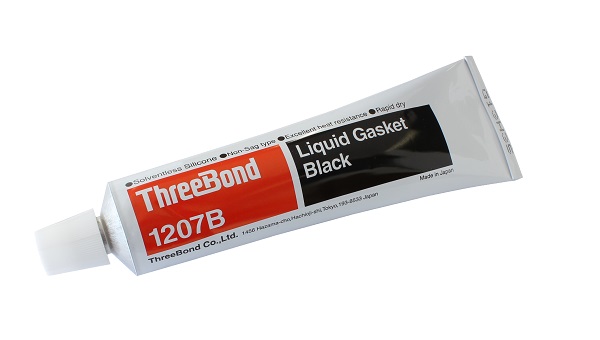
1200 Series silicone-based liquid gasket fills gaps on a flange surface and thus completely prevent leaks. When cured, it forms an excellent rubber-like elastic body offering excellent resistance to vibration and shock. Also it has an excellent resistance to heat, and effectively seals joints that are subjected to high temperature.
Here's the specification for Threebond 1207B:
 I now have a tube of this. It has a Honda label & part number!
So many choices - but which one?
In the old days, in these situations I used to use traditional Red Hermetite or more recently Wellseal. I've also use blue Hylomar in the past. Usually the selection is made on the grounds of availability - what I had in the toolbox at the time.
I've no real engineering information for any of these products, and have never made a proper assessment of them.
However, for the SQ4 I wanted to look at a modern sealant. I hope to avoid tearing the engine down again anytime soon and with the legendary folk tales of excessive engine temperature (300 F at the plugs) I wanted to make sure I had something which was:
- suitably rated for temperature
- compatible with engine oil
- compatible with aluminium
- a suitable colour (i.e. not red & smeared all over the cases!)
Threebond describes itself as a fine chemical technology company with its roots in the automotive industry. Apparently, more than 90% of the world's motorcycles are assembled using Threebond products. Probably worth a look then!
1200 Series silicone-based liquid gasket fills gaps on a flange surface and thus completely prevent leaks. When cured, it forms an excellent rubber-like elastic body offering excellent resistance to vibration and shock. Also it has an excellent resistance to heat, and effectively seals joints that are subjected to high temperature.
Here's the specification for Threebond 1207B:
- Excellent chemical resistance against coolants and engine oil
- Outstanding mechanical and thermal resistance
- Excellent adhesion even to slightly contaminated surfaces
- Extremely fast curing
- Instantaneous impermeability for pressure- and fire test.
- Acceleration of the curing process by heat and contact with the medium
- No shrinkage and no generation of corrosive gases
- No corrosion of metal and only very slight reaction on plastics
- Normal disassembly


