Sunday, 2 October 2016

Debris in the pilot circuit

It's amazing what a small piece of debris can do. Coming back from North Walsham the other day, close to home, the SQ4 decided to die every time I closed the throttle, which made slow speed cornering somewhat unnerving and junctions, especially one on a hill, something of a strain. Ever tried to kick start a heavy bike while holding the throttle open and the front brake on with one hand?

Fortunately, the starter circuit and the main jet were fine, and I got home under my own steam.

Fuel for the pilot system comes from the float bowl and is controlled by a jet screwed into the hole in between the float bowl and the emulsion tube:


It passes into the large hole in the top of the carburetter:


And out of the round hole positioned at 10 o'clock in the square flange:


Then it passes through the gasket into the annular machined groove in the throttle body


The pilot mixture passes into the hole at 6 o'clock. From here, it goes forward to the idle screw, and passes around there into the engine when the throttle is closed; additionally, there is a hole near the butterfly which provides additional mixture from the pilot circuit as the throttle opens, to prevent a flat spot occurring before the main jet is active.

Stripping the carburetter down revealed a little gremlin in the pilot jet:

Poor focus macro picture of a jet with extracted debris
Quite enough to disrupt the flow of fuel into the pilot circuit. All fine now.

Sunday, 25 September 2016

Norfolk Motorcycle Museum

A bright sunny day, a day off, a wife looking for a few hours to pamper herself and a dog with a poorly foot leads to a day in the garage or maybe, since the SQ4 had not had any exercise for a while, a little trip out.

In a big shed attached to old railway buildings at North Walsham lives an interesting collection of over 120 motorcycles from the 1920's to the 1960's, put together by George Harmer, and looked after by George, his son Steve and a few enthusiastic volunteers. The museum opened in 1993.

It's more like a cross between a traditional bike shop and a museum, than a regular museum. I went to the National Railway Museum at York a few years ago, which is full of shiny railway locomotives and other exhibits in a spotlessly clean environment. Now, maybe I'm spoilt by living tens of yards from one of the best standard gauge heritage railways in the country, with all the grime, smoke & smells that that entails but it's taught me that I don't like museums filled with cold, dead, trains, cars or motorcycles.

So for me, this place is great. If you are old enough to remember Happy Hamrax, Joe Francis Motors or any of yesterday's bike shops - oily floorboards, dusty old bikes, shelves sagging with boxes of obscure bits - then you will love it.

Here's a few of the pictures I took while I was there - just things that grabbed my attention.

One of my favourites - Sunbeam S8

Velocette Valiant

Two Ariels - Arrow & Leader

Royal Enfield Robin diesel

Here's an overview of the museum, to give you an idea of the scale:


Another general view:


One of Val Page's finest - a 'Black' Ariel:


A Henderson Four:


A gem of British engineering - a Rudge Radial


Close up of the cylinder head showing the pushrod operated radial valves:


The museum has exhibits in varying states of restoration:


Slightly unusual, the Puch 'split single':


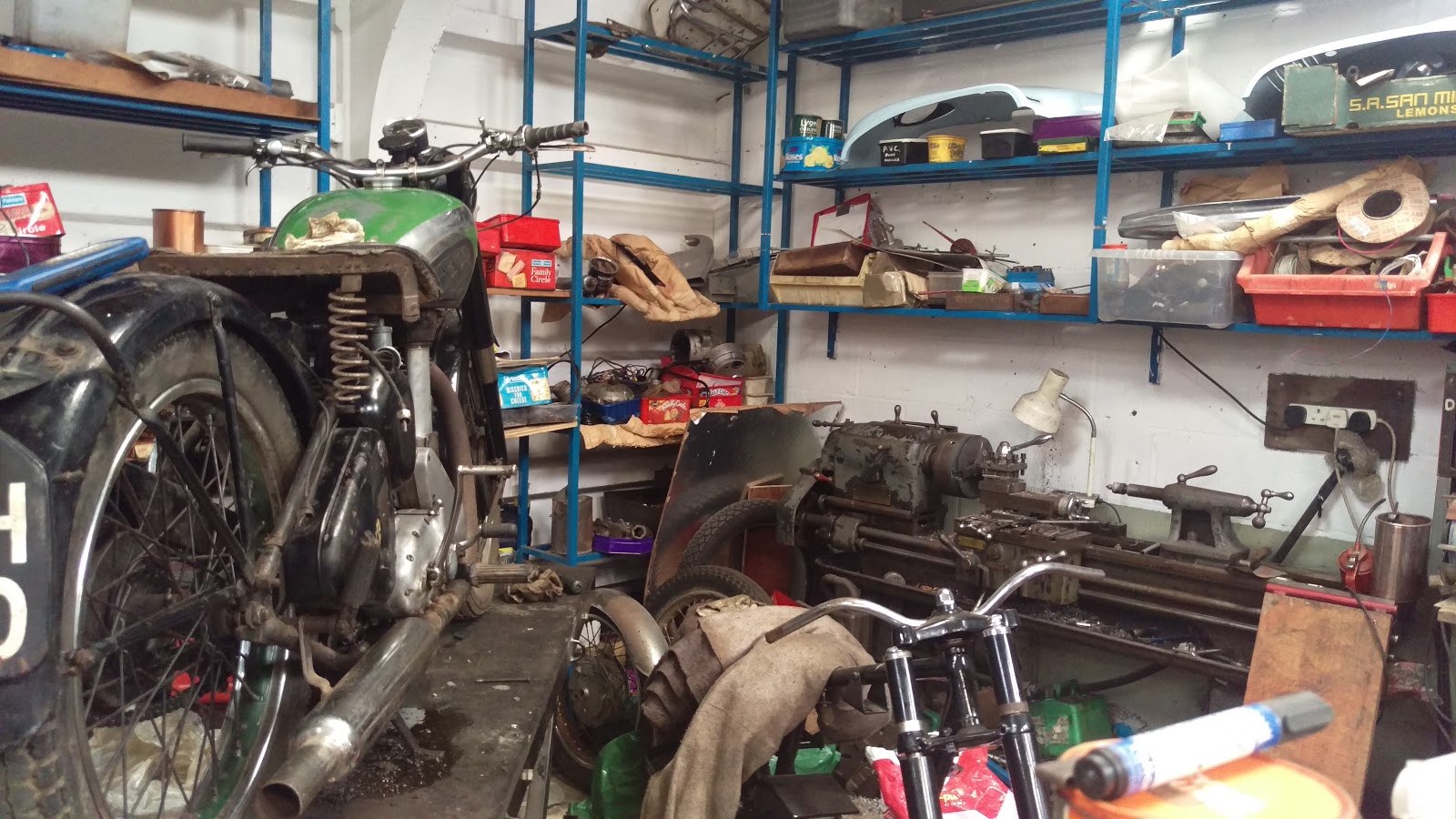
Here's the most interesting corner of the museum - the workshop!


Saturday, 17 September 2016

Ariel W/NG at 1940's weekend

A couple of nice military bikes at the 1940's weekend in Sheringham last year.

Here's the Ariel W/NG from the Norfolk Motorcycle Museum:


And a visiting Royal Enfield WD/CO


A G3L pictured this year:


At the Norfolk Motorcycle Museum, I was lucky enough to be able to take some close up pictures of their W/NG:
0.303" period accessory
This bike is based on a frame that would have shipped from Selly Oak in the summer of 1944. Original aluminium cable strap:


Rubber cable sheath; no steering damper on this late machine.


Late 1941 engine.


Usual Ariel decompressor arrangement, and with rocker cover spring clips.


My favourite subject - curly copper fuel line.


Steel primary cover:


And again


Horn bracket, similar to mine:


And again:


Late footrests:


These are Ariel's tapered handlebars:


Original brake rod:


Another favourite subject - speedometer brackets:


Again:


The brake lever is straight:


Mine is cranked:


Here's Steve Carter's:


Saturday, 10 September 2016

Fuel Cap

Back in an earlier post I commented that the fuel tank cap was not a proper Ariel one:


Fortunately I had an old one lying around which I had dismantled by drilling out the siezed centre screw. The female thread in the cam plate was just about usable:


All I needed was a new seal, cut from a sheet of neoprene and a new centre screw which I bought from Drags


I made a new 'stiff nut' using a 5/16" BSW nut, a hacksaw and a hammer:


All together and in place. Looks the part, though the centre screw is too domed: